
How to Build a Sales Playbook That Your Team Will Actually Use
Most founders can close deals. What they can’t do is explain exactly how they close deals, and that gap is what kills growth. When you’re ready to hire your first sales rep or hand off a territory, “just watch me do it” stops being a strategy. That’s the problem Drew Williams has spent 17 years solving.
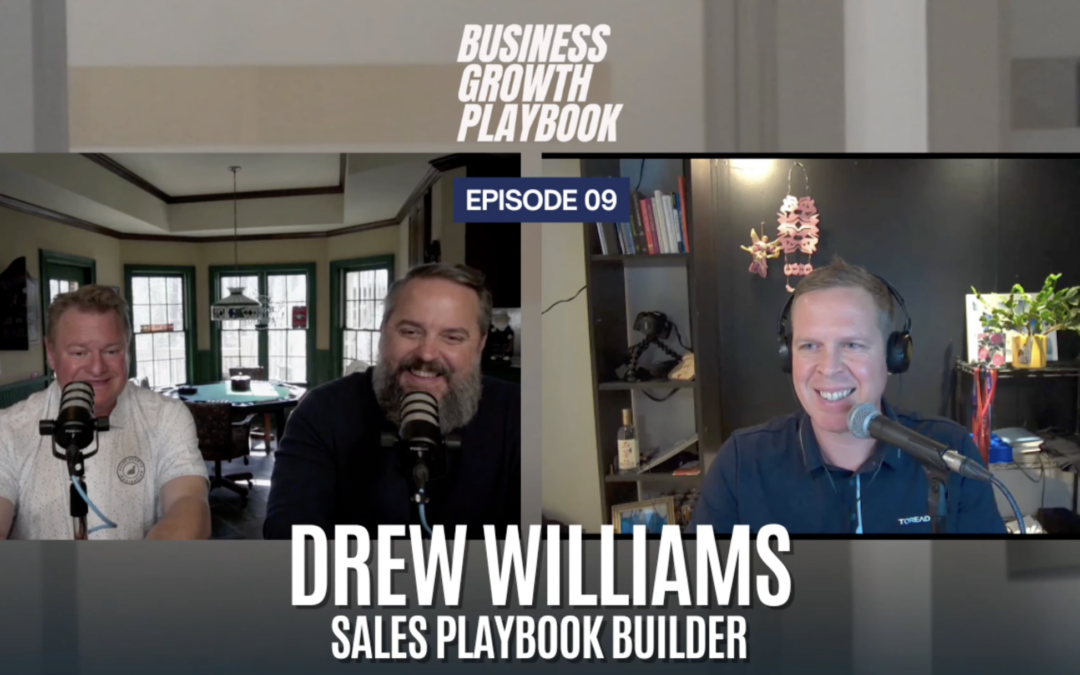
Williams is the founder of Sales Playbook Builder AI and a sales growth specialist who has worked alongside Dan Martell as a SaaS sales coach and partnered with organizations like Predictable Revenue and Sales Acceleration. In a recent episode of the Business Growth Playbook, he sat down with hosts Jeff Evans and Dean Nolley to break down what separates a sales playbook that drives revenue from one that collects digital dust.
The Problem Every Early-Stage Company Has
Here’s the pattern Williams kept seeing across founders and early-stage companies: brilliant products, zero documented sales process. The founder knew how to sell. The team did not. And without a written, repeatable framework, every new hire started from scratch.
A sales playbook fixes that, but only if it’s built correctly.
Williams is direct about the difference between a real playbook and what he calls “AI-generated slop.” A tool that spits out a generic document in five minutes might look like a playbook, but a sales team will see through it immediately. What actually works is a playbook built with real expertise behind it, something that reflects your actual buyers, your actual objections, and your actual process.
The Three-Step Framework: Input, Process, Output
The core of Williams’ approach is a structured three-step framework:
-
Input — Deep discovery into your product, your customers, your competitive positioning, and what has worked in past deals
-
Process — A structured methodology that organizes that raw material into a coherent, stage-by-stage sales motion
-
Output — A finished, usable playbook your team can open on day one and actually follow
What makes this significant is the compression. Work that used to require 40 to 60 hours of manual consulting gets done faster without sacrificing the quality that makes a playbook worth using. The technology handles structure and synthesis. The human expertise handles judgment, nuance, and accuracy.
Tiered Options for Every Stage of Business
Not every company needs the same level of playbook, and Williams built his platform to reflect that. The tiered model runs from a standard playbook for early-stage teams who need the basics documented, all the way up to architect-level customization for companies with complex sales motions, multiple buyer personas, or enterprise deals in play.
The right tier depends on where you are. A five-person startup closing $15k deals has different needs than a 50-person team working six-month sales cycles. The important thing is that you start somewhere, because no playbook at all is infinitely worse than an imperfect one.
Why Refreshing Your Playbook Matters as Much as Building It
One of the most overlooked points Williams makes is that a playbook is not a one-and-done project. Your market shifts. Your buyers change. Your competitors adjust. A playbook built two years ago may be meaningfully out of date today.
Williams recommends treating your playbook like a living document, with a formal refresh on a quarterly or annual cadence depending on how fast your market moves. Companies that skip this end up with reps following outdated messaging and wondering why their numbers are slipping.
Using a Sample Playbook to Open Doors
One of the more creative applications discussed in the episode comes from host Dean Nolley, who has been using sample playbooks as proof of concept when approaching new clients. Instead of explaining what a playbook is and why they need one, he shows them. The sample does the selling.
This works well beyond internal team training. A well-built playbook signals to prospects, partners, and investors that your sales operation is professional, repeatable, and ready to scale.
The Truth About AI in Sales
Williams does not sugarcoat this part of the conversation. There is no silver bullet, and companies that go looking for one tend to end up with expensive tools nobody uses. Technology is genuinely useful when it is paired with real expertise, clear inputs, and a commitment to actually using what gets built. Without those things, you get a polished-looking document that nobody trusts and nobody follows.
The companies getting real results are the ones using technology as a force multiplier, not as a substitute for thinking.
If You Have Customers, You Have a Sales Process
Every founder who has ever closed a deal has a sales process. It’s just stuck in their head. The goal of a playbook is to pull it out, structure it, and make it something you can hand to a new hire, a new partner, or eventually an acquirer who wants to know exactly what they’re buying.
Getting your process out of your head and onto paper is one of the highest-leverage moves you can make for the long-term value of your business.
To connect with Drew Williams, search “Drew Williams Sales Playbook Builder” on LinkedIn or visit salesplaybookbuilder.ai.
To connect with the hosts, reach Dean Nolley at salesgrowthimagination.com or dean@salesgrowthimagination.com, and find Jeff Evans at jvincentcreative.com.
Would you like me to add a meta description or adjust the keyword focus for a specific audience?